Showing posts with label Awareness Week. Show all posts

Friday, August 1, 2014

Top Ten Zen #9: Finding Joy


Hi blog,

We're almost to the end of our mini-epic series of Zenocity! (I don't think that's a word actually...) Just one more after this. I'm already feeling a little nostalgic. What a funny looking word that is...


Top Ten Zen

Andrew and Nick have compiled a list of Zen-like philosophies comprised firstly of a quote, an interpretation of said quote, and finally a story to drive their point home. This list can aid you in doing anything from completing a 100-mile race to surviving cancer, or obtaining any goal you set your mind to. 

Here are the previous posts for those who missed them:
  1. The journey of a thousand miles begins with a single step
  2. Body follows mind
  3. The faster you hurry, the slower you go
  4. You are not bound by your past
  5. Life is only available in the here and now
  6. You are the author of every next moment
  7. Your worst enemy lies within
  8. Once we accept our limits, we go beyond them

Free sledding

"Find joy in every little thing."


The Survivor’s Take: When facing hard times, it pays to find things to make you laugh and smile. Problems don’t seem as heavy when you take them on with a grin and a giggle.
The Runner’s Take: Smile, look up and enjoy the scenery. Stomp on the flowers if they provide you better grip on the climb, but don’t forget to smell them!

Survivor’s Tales: Anyone who has been in the hospital will tell you it’s a pretty boring place most of the time. (It’s generally not a good thing when it gets interesting though.) So to pass the time, and also to keep my spirits up, I played practical jokes. My favorite involved a spoon, some Jell-O, and a very pale nurse. I was too weak to eat the Jell-O myself at the time, and after my mom missed my mouth once with the spoon, I got an idea. We set up, giggling like mad, and put on our game faces as we called in the nurse. Neither of us would specify exactly what happened, only that we “Needed the nurse to get in here right away.” A couple minutes later the nurse showed up and froze as she saw me clutching my eye, little bits of red Jell-O oozing from between my fingers. “She got me in the eye,” I groaned. The nurse turned white as a sheet and quickly spun around, muttering something about getting the doctor. Luckily she had a good enough sense of humor to laugh with us after we stopped her. Finding funny things to cheer you up, whether it’s something as simple as reading a joke book or something as elaborate as a harmless prank (harmless being key), will help get you through the tough times if you remember to laugh as often as possible.

Mountain Tales:  I was coming off of the backside of a notoriously difficult mountain pass. The descent was steep and covered in long patches of dirty snow. I watched as the runner ahead of me plodded down the top of a long snow chute. The runner suddenly slipped and started sliding off down the chute at great speed. I was worried and opened my mouth to yell out to him. But then all of a sudden, he recovered just before he would have careened into the sharp rocks below. He picked himself up and kept moving as if he’d meant to do it all along. Anxiously, I moved closer to the snow chute, plopped my butt down as I’d watched the runner before me do and swoooshh!! I was off lightning fast! Whatever material my shorts were made out of was much faster on snow than the runner before me. I was horrified but I smiled and laughed. The laughter was partially out of fear, partially from the adrenaline, and partially from the fun of getting to sled in the Pyrenees for free! For that brief moment, the competition and the race faded away. I shook off the snow from my shoes and smiled back up at the snow chute, happy to be alive.


How it probably looked to the nurse


Andrew would like to point out that he actually mentioned his story and talked about using humor as a tool to get through cancer treatments in a previous series of his, Awareness Week. The specific post was: Awareness Week: Surviving Cancer, where he mentioned five different methods that could be used to get through the rough treatments and dark times that come along with cancer and the after-effects.

Of course, just because we are sharing our own extreme examples does not mean that these philosophies are all strictly for extreme situations. We share these because they can be used by anyone in the proper situations and we invite you, dear reader, to take these helpful tips into the world to use as you see fit. Feel free to hoard them or share them with others. It is both of our hope that these do some good somewhere, and so we wish you luck in your journey of a thousand Zen-filled steps.

Nick Hollon
Andrew Bundy

Saturday, May 10, 2014

Reunion With a Mission

Hi blog,

I'm still waiting for the day you say "Hi" back blog, although I suspect it will unnerve me to no end.

Firstly, I saw Nick on Thursday and after hearing about my imploding shoulders he came over and gave me a bottle of Skele-Gro, filled with a "magical elixir" that may or may not have been untreated lake water stuck in an old bottle with a label printed up for minor comedic relief. He'll forgive me for being somewhat dubious.
My dubious face and toothpick


Anyway, getting on with stuff and all that. Yesterday was the 38th Annual Bone Marrow Transplant Reunion at City of Hope in Duarte, CA (which is near Los Angeles). I went up with my parents to what I assumed would be a gathering of a hundred people or so and doctors and a couple famous people to talk for a little bit and all that. Yea, no. There must have been upwards of a thousand people there underneath a forest of large tents and amongst a minor labyrinth of booths and food stops of all shapes of sizes (and cupcakes!). And while indeed there were some famous guests (such as comedian Sean Kent and musician George Winston (link: Musician George Winston has new goal: Say ‘thank you’ in German, a brief article about Mr. Winston meeting his German bone marrow donor)), there was also a young girl around nine years old who played a touching rendition of Kermit the Frog's Rainbow Connection on the ukulele (which she first played for her doctor during treatment) and I'm pretty sure I heard sniffles all around me in that giant tent. Many a handkerchief and tissue were pulled out, I assure you it was very much warranted.

Left to right: Pamela Bundy, Dr. Anna
Pawlowska, Me, and Bill Bundy
I think for me though, the best part about going to the reunion was getting to see one of my oncologists. Dr. Pawlowska (a name I can now spell without any assistance at all, which she thought was rather humorous), whom I haven't seen in several years. The last time I saw her, I weighed an extra fifty pounds and had no hair (that part hasn't changed, as you can tell by the pictures). She greeted me with a patently thick-accented "Wow! You look excellent!" That's definitely one thing you really like to hear from someone who saw you at death's door once upon a time. The five of us (one of the social workers I knew from the hospital was there as well) talked and I discussed what was going on in my life and how things were going (keeping a positive spin on all of it). She was particularly interested in my book and wants a copy of the rough draft when I finish it. Of course, she'll also get a signed copy of the first edition when it goes to print, but that goes without saying.

I did have a secondary mission, co-crafted by myself and Nick, for when I went to the BMT Reunion. I brought with me a handful of information packets describing both Nick and mine mission statement (talking about who we are, our information, what we're working on (the books), and why we're doing it) and also a little about the two of us, including excerpts from our books. I still had several copies left over by the time I was about to leave, so I leapt into salesperson overdrive and handed them out to random people, giving them a brief synopsis of mine and Nick's tale and what the small document was I had just stuck into their hand. I wish I could have better explained it to them and really given them a better idea of what was going on when I handed them the papers, but I only just managed to give out the last one by the time my dad drove up in the car, and with City of Hope being near LA, the sooner we left, the better. Traffic added an hour onto the drive back, which actually isn't too bad, you know, considering it's LA.


To the people who got the handouts: I would like to briefly mention that I have written a kind of Awareness Week series of posts that discusses helpful tips for cancer patients and survivors that you or someone you know may find useful. Please feel free to pass them along if you think they will help.
Awareness Week Part 1: Surviving Cancer
Awareness Week Part 2: Combating Side Effects
Awareness Week Part 3: Life is Mental


On a side note: I also reaffirmed what a light sleeper I am. I love toothpicks, and when I take micronaps or suspect I might fall asleep but am already chewing on a toothpick, I just tuck it behind my ear for safekeeping. Well, I was resting against the window and mostly asleep when I felt the toothpick start to slide out from behind my ear. This brought me out of sleep just barely, but once the toothpick fell out and into my lap I jerked away as though there had been a supernova ten inches from my face (actually that wouldn't have woken me up so much as completely vaporized me). Yea...light sleeper.


Earlier in the post I mentioned the mission statement Nick and I crafted and it dawned on me that it might not be a bad idea to include it. So...


 Life Has No Title by Andrew Bundy and Ultra Souls: The Tale of Mr. 3000 by Nickademus Hollon are separate memoirs that follow the lives of two friends whose paths are pulled apart by cancer yet grounded through friendship. These memoirs document unique, vivid stories told from entirely different perspectives. Life Has No Title follows Andrew on his journey through hell and back, from the diagnosis of Acute Myeloid Leukemia to fighting tooth and nail through post-cancer treatments and surgeries, each leaving their own multitude of scars both physical and emotional. His story is inspirational and filled with laughter, tears, pain, misery, and hope. By providing a tale of survival against all odds this book proves that no matter how insurmountable life can seem at times, there is always a chance and always hope.
Meanwhile, Ultra Souls: The Tale of Mr. 3000 is the other side of the coin. The book follows Nickademus after he’s deeply moved by his friend’s diagnosis. During his last year in high school, Nickademus embarks on a project to run 3000 miles in order to raise awareness and funds for his friend Andrew. During the project, he discovers his passion for running long distance and quickly begins a career in Ultra-Marathon running, taking on and winning some of the world’s most difficult foot races. The two books are intertwined stories of survival and what it’s like to live on the fringes of existence. These tales of determination, depression, will, anger, and hope are told from two entirely different perspectives, yet crafted together through an enduring friendship strengthened through adversity.

Andrew Bundy is a survivor in every sense of the word. he was diagnosed with cancer at the age of 18, just weeks before graduating from high school. After multiple rounds of chemotherapy and scores of treatments and surgeries, Andrew has come out of it all as a survivor. He hopes to use his love of writing and his painful, yet inspiration tale to change the lives of others for the better.
Nickademus Hollon is a professional endurance athlete, most notable as the world's youngest finisher of the Badwater 135-mile footrace and winner of the 2013 Barkley marathon, a notoriously difficult 100-mile footrace. Nickademus is constantly pushing the limits of human potential and uses his gifted athleticism to motivate and inspire others to do the same. 


Anyways, that's all for now. Blog, thank you for taking the time to let me write you. I know it must be somewhat tedious, albeit exciting that you actually have some activity and so much of it! I'll let you take your pick of which one is true.

Your long-winded ruler,

Monday, March 31, 2014

Relax

Hi blog,

I would like to thank you for allowing me to co-opt you for Awareness Week. I know that you had to sit through a lot of advice that doesn't pertain to you, because you aren't biological at all, but it was for a good cause and I know you like helping people so it works out for all of us.

To the humans: I am very appreciative of all of you who spent the time to read through Awareness Week posts and even more appreciative of those who shared them with others. Of course, just because Awareness Week is over doesn't mean that you can't share it anymore. If you think of somebody who might be able to use any of the advice given, please, please, please share it with them!

Sharing is caring!
As a present, both to you (the blog) and to the humans who have supported me through my attempts to provide useful information to those who need it, I have a fun, light short story. You can share that as well! It's also actually a good visualization tool (see the post Awareness Week: Life is Mental for more details) for those who have stress or anxiety in their lives. Maybe it'll help somebody as well!

Relax

The dull, incessant ticking of the second hand seemed to grow inexplicably louder with every little click. Growing and building on itself like some gluttonous monstrosity until it became so gorged it burst. Bursting would be good, I decided, then the damn thing would be quiet. It just never seemed to get to that point. Even as three o’clock in the afternoon rolled by in my dingy little colorless-themed cubicle, the seconds ticked on by louder and louder until they were a crashing roar in my head. The florescent tubes burned holes into the back of my brain, a harsh glow cast upon my dreary social prison. 
I stared blankly at the computer screen, which had been frozen on a graph for the last hour and a half, a graph that I was supposed to clean up and present the next day. Briefly, I wondered if it was possible to get permission to go home if I mysteriously wound up with a staple in the middle of my forehead. The stapler whispered for me to give it a try. That was disconcerting. I ignored its pleas to taste human flesh and drummed my fingers on the unresponsive keyboard while I waited for someone from IT, whom I was beginning to become certain had been sucked into some interdimensional portal. Or was busy. One or the other.
“At least try it!” the hungry stapler grumbled irritably.
“I am not going to slam you into my forehead,” I told it sternly, and the office supply fell mercifully silent. The last thing I needed was someone to come by and wonder why I was talking to a stapler. I hate slow days.
All around me the tapping of keys rose up from beyond the flimsy excuses for walls that served as my three-sided cell. The sound drifted above the barriers and seemed to taunt me and my inoperable device. I considered threatening it again, but you can only mutter death threats to a computer so many times before it becomes weird, and I had easily surpassed that limit five minutes into the malfunction.
As I rocked back and forth in my squeaky office chair, content that any noise was better than the cacophonous roar of the passing of time, I looked around my desk and spotted the one welcome sight in the building: empty space. With nothing better to do, I rolled my chair over and folded my arms atop the only place I wanted to be and laid my head on them. My eyes fluttered closed almost immediately, the backs of my eyelids a much needed respite from the unnatural glare of modern lighting.
A couple years ago I  had learned a neat relaxation technique called visualization. You imagine yourself somewhere relaxing and inviting. Somewhere you would vacation perhaps, or somewhere that appeals to you. Little by little, you add in more details until it almost feels like you are there. It is a wonderfully helpful tool for me, but not one I have many opportunities to practice. If ever there was a time though, this was it.
Mine is a little different from the normal destinations of a warm sandy beach or a deserted island or a clearing in the middle of a forest. I like to picture myself floating on a bed in a warm tropical sea on a clear summer’s night. So I did.
I took in a deep breath. The saline perfume wafted into my head and brought a proto-smile to my previously tense lips. I could nearly taste the salt in the air as I took my next breath, the smell pervading my senses and surrounding me in a cocoon of inviting briny fragrance. The teasing aroma grew more tangible as I inhaled a third time, and this time I really could taste the froth of seawater dancing on my tongue like some pleasantly stinging ephemeral jellyfish.
Now I envisioned the bed. My back resting on a silky puffy comforter, my head on a gooshy foam pillow. I could feel the back of my head sinking down into the foam, the walls of the indentation pressing ever so light against the sides of my head, mashing my hair against my skull in a tender caress. With my hands folded on my chest, the silken feel of fabric against the backs of my legs, I stretched out as far as I could, never quite reaching the end of the bed, which was always the perfect length.
The drone of the clock faded away, graying out until the obnoxiously boisterous ticks became lost in the swelling sound of water licking at the sides of my bed. The gentle sea lapped at the sheets hanging down, splashing fairy droplets onto my upturned face, causing the strength of the smell to undulate with each diminutive wave. Somewhere in the distance, a gull cried out and was met with a chorus from its family. A splash far away signaled a breaching whale. The salty sloshing sea murmured all about me, echoing for eternity in every direction around my cozy raft, with only nature surrounding my floating island sanctuary.
Finally, with all the other senses in place, I opened my eyes. My heart leapt in my throat as a vivid, moonless night sky stretched before me. Thousands of pinpricks of light shimmered and winked down at me. A vast band of dust streaked across the horizon, cleaving the dark, star-spotted veil clean in two. Small smudges could be found nestled in between the brilliant luminous balls, distant realms far, far away from my perfect isolation. I could pick out the constellations hanging above me, and traced their outlines with an outstretched hand as though I were painting them in place for all to see, though this would be for my own private gallery. As I did, a fiery streak glowed white-hot as it crossed the twilight dome in a glorious, short-lived burst that left a green afterimage burned into my vision, flitting across my sight like a playful wraith.
The last thing to do was let go. Part of me was still thinking about my report, was still wondering when the damnable IT kid would show up to fix my malevolent computer. I knew what to do though. I took my hands and placed them as though I were cupping a small ball. Focusing intensely, I imagined all of my worries, all of my concerns, everything from the life outside of my pocket universe, and put it in a bubble. I watched as a small spark lit up smack-dab in the middle of the void between my palms and slowly grew into a perfect, glassy sphere with a shimmering surface painted with images from the life I was about to release into the ether.
Raising my head up off the pillow, I leaned forward with my lips almost pressed to the thin film of reality, and lightly blew on the weightless orb, watching as it drifted away higher and higher toward the dust lanes of the Milky Way until I blinked and could no longer see it. There was an empty feeling in my chest where once a knot the size of an office building had once sat. The pit was soon filled by a torrent of beauty from the world around me, crashing in and washing away the last vestiges of anxiety and apprehension, leaving me perfectly satisfied to drift endlessly through the infinite ocean of my new home, with only the sea life and the far-flung heavenly bodies to keep me company. What I am now is a lone witness to all of this stunning, radiant beauty. And really, you can’t get any better than that: a familiar, comfortable place to take in the breathtaking scenery. A place to just…relax.


Your mildly benevolent wordsmith, Andrew

Friday, March 28, 2014

Awareness Week: Life is Mental

Hi blog,

Well, today is the end of Awareness Week, it's the last post. Subsequently, I also think it might be the most important. This post isn't just for cancer patients and survivors, it's for EVERYONE. Not only is there a little something for everyone to take away, but there's also an enormous amount of awareness (go figure) embedded within the words that will follow these. So sit back (or forward, maybe stand if you want, whatever you like), hold on, and use your eyeballs.


Cancer isn't just about cancer. I can hear you scratching your heads from here (might I suggest a better shampoo?), but hear me out. The actual cancer itself is just part of the problem, there's so many more aspects of the disease that come into play, both directly and indirectly. In my previous post I discussed two side effects that don't get a lot of attention, but left out the most important of all side effects. It's an almost taboo subject in our society, regardless of whether or not you've had cancer. But for cancer survivors, it's one of the biggest hurdles for recovering and living a normal life. It's something I have struggled with for some time and am slowly making progress on. Give up? It's a little something called "mental issues." (Although I suspect the title might have given it away some)

Yes, mental illness is extremely common amongst cancer survivors and patients. It makes perfect sense when you think about it, but most people don't. It is an underwhelmingly undiscussed topic both in cancer recovery and in life in general. People hate talking about mental illness. My theories on why this is the case are not relevant to this blog, although I have several. The goal of Awareness Week is to spread, wait for it...AWARENESS about the problems that cancer patients and survivors must go through. It is an enormously difficult thing to piece your life back together after being dealt such a crippling physical blow, but you and everyone around you is so focused on getting your physical health in as good a shape as they can that often your mental state is neglected to some degree. The people around you, those who are supporting you, don't really understand that not only are you battling the cancer, but also any range of mental and emotional problems such as: depression, anxiety, paranoia, intense anger, panic attacks, nervous breakdowns, manic behavior, suicidal thoughts and tendencies, and the list goes on.

There are a few aspects of this topic that I would like to cover. One for the patient/survivor, and another for those supporting them.

How to cope with mental pain:
  • Depression: Probably the most common feeling associate with a cancer diagnosis, both for the patient and their family and friends, depression can be a difficult problem to kick. Remember that there are social workers at the hospital who are used to talking to cancer patients and have a sympathetic ear, they will listen if you talk to them. Also, don't be afraid or ashamed to ask for
    anti-depressants, they can help to improve your mood to some degree and (if you read the first post) being in a better mood can actually increase your chances of survival. Another good way to stave off depression: laugh (mentioned in the first post). By laughing, you are telling yourself that things aren't completely hopeless, that you can still find joy in the world. Finding some happiness  will go a long way toward dispelling some of that darkness that threatens to cast a pall over your thoughts. One last tip: talk to yourself. Tell yourself that you are feeling good and that you will get through this. At first, it will seem silly and like you're lying to yourself, but if you repeat this to yourself often enough, you will start to believe it and it might make all the difference in the world.
  • Anger: It begins with the diagnosis itself. Being told that your life is about to radically change, likely forever, is enough to rock even the most thick-skinned people to their very core. There is a sense of betrayal, your body has turned on you and is eating you from the inside out. That's normal. Anger is normal. It is extremely difficult to be able to direct all of that hate and fury to the cancer though, because you can't necessarily see it and so a lot of the anger ends up transferring to people around you. Inevitably, you will snap at somebody you care about for doing something that normally would not bother you in the least, but without an outlet for your anger, you will lash out at those closest to you. It is your duty to apologize and let that person know that you didn't mean it. The best thing you can do to actually deal with the anger is to find an outlet for it, whether it is in violent video games, beating a piñata, or yelling into a pillow, if you can find a method of dispensing that anger into an inanimate object, it will alleviate the rage to some degree.
  • Anxiety: Probably the issue that I have the most problem with myself, anxiety can be a nearly crippling force that threatens to overwhelm you in every possible way. Luckily, there are a number of anti-anxiety medications available and this will dull the most potent effects of the  
    anxiety. It would help to learn some relaxation techniques (Relaxation Techniques for Stress Relief) as well, as this will serve to calm your thoughts and sooth your racing mind. Personally, I find that deep breathing (easy one: breathe in for 5 seconds, hold breath for 5 seconds, breathe out for 5 seconds, hold breath for 5 seconds, repeat as necessarily) and visualization (slowly putting yourself into a relaxing scene, like being on the beach, be sure to include all 5 senses) are the most helpful, but these methods differ from person to person and you should be encouraged to try as many out as you want to find the ones that work best for you.
  • Suicidal thoughts: Obviously the most dire of mental problems, if you (or the person you are supporting and/or caring for) starts to have suicidal tendencies or thoughts, you should tell your doctor right away so you (or they) can get the help that they need. This is not something you should tackle on your own, the stakes are too high for that. When things are this bad, you want as much professional help on your side as you can get. Here is a link to the Suicide Prevention Lifeline: click here.

How to offer support: To those who are trying to support somebody going through cancer, it can be a difficult experience for you as well. Watching somebody you care about slowly deteriorate before your eyes can be an excruciatingly painful experience. It might feel awkward to be around them because you don't know what to talk about and don't want to feel insensitive or like you're babying or pitying them. Sometimes this causes people to drift or pull away, and the support for the cancer patient or survivor will almost always dry up to some extent as time passes, but the people who care the most, the ones who the patient can count on, will stick with them even through the bad times. As a cancer survivor and somebody who lost quite a lot of support almost immediately after finding out I wasn't going to die, I have an inkling about the sort of things that work best for helping to support your friend/family member who is going through their treatment/trying to put their life back together afterward. Here are a few friendly tips for supporting the person you care about:

  • Treat them like a human: There is nothing worse than having every damn person give you a pitying glance when they find out what you're going through/have been through. It doesn't make somebody any less human to have gone through cancer, they are still the same person you used to know, so treat them like it! They will still like the same movies (most likely, unless it's a sad movie about cancer, then probably not so much), enjoy the same jokes, like the same music, but for some inexplicable reason people start to act like the survivor/patient is five-years old and needs to be coddled at every step. We don't. We want to be treated like an actual person, who deserves all of the respect and friendship that we had before we got sick. 
  • Share things with them: Don't feel like you have to hide aspects of your life from somebody just because they're going through cancer. You may feel guilty for being able to enjoy life while they're stuck in a bed, but you shouldn't. Cancer treatment is characterized by very boring periods followed by short, intense periods of crazy stuff. During those boring times, it helps to hear how  friends are doing and learning about their lives, sometimes it allows patients to live vicariously through you. Just because a patient is undergoing chemotherapy does not mean they don't want to hear anything about you. If you have a funny story about a bad date that you went on last Friday, tell it! Don't feel bad about sharing your life with them, they won't hold it against you that you aren't sick. 
  • Stick with them: It will be a hard thing to watch at times, but the single most reassuring thing for a cancer patient is to know that your friends are there for you when the going gets tough. It can be demoralizing when somebody you've known for years stops coming around and won't return your calls, it can make you feel abandoned. As their friend, you want to try and keep the person going through their cancer treatments in as good a mood as possible (see above). A very simple way to accomplish this is to put aside your discomfort for a few minutes and take the time to visit, call, or even just text them and see how things are going. 
  • Don't give up: Sometimes it is difficult to believe things will be okay. Sometimes you know things won't be okay. This does not mean you should just give up and stop trying to help. In fact, that is precisely when you should be even more supportive. When things get bad, it is imperative that the cancer patient gets as much encouragement as possible to help them get through it. As their friend/family, you have an opportunity to lift their spirits and help them fight off any feelings of hoplessness. If you hear them talking about giving up, don't be afraid to call them on it and tell them they are being ridiculous, because they are. Never let them give up, and you shouldn't either. Miracles can happen (I'm walking proof of that, I shouldn't be alive), so always have faith and be as supportive as human possible (and a little more).
And the last thing to remember is that there is no shame in having issues with your mental or emotional health. It is a very common side effect of going through cancer and the treatments associated with it. Ask for help, follow the guidelines above, and remember: things will get better if you believe they will get better. Life is 85% mental, your brain has a mysterious way of molding physical health and can be one of your greatest allies. A positive attitude is your greatest weapon. 

And supporters? Be there for them, they need you now more than ever. You have the power to help save their life, don't forget that. Make them smile, show them you're there for them, and never, ever give up on them.

Well, that's it for Awareness Week. I hope that you have learned some useful facts about cancer, cancer treatments, side effects, and ways to cope with all of the above. If you know somebody who is currently going through cancer, has gone through cancer, or has friends or family doing either of the former, please share this with them and spread some awareness. Hopefully by getting some of this information out there, we can all help change perception of cancer and learn how to better hope those who are forced to endure it.

If you have any comments or facts you wish to share, please post them in the comment section below (that's why it's there!). Have a wonderful day.

And blog? Thank you. Sincerely, your boss, Andrew

Wednesday, March 26, 2014

Awareness Week: Combating Side Effects

Hi blog,

I will continue to commandeer you for Awareness Week until, well...the end of the week I guess. You'll thank me later. Maybe. If not, then you'll have to forgive me, and if you can't, well that's not my problem at that point.

Today I will discuss some of the side effects that come about as a result of cancer and the treatments involved with it. I'll deal with short term effects for this post, and while non-cancer patients might not find this particularly useful (unlike my previous post, which was partially helpful in general), you may know somebody who might find it helpful in one way, shape, or form, so please, do that person a favor and pass this on.

Pass it on!
Many of us know about a couple of the physical side effects of cancer treatments like chemotherapy and radiation: the nausea, hair loss, lack of energy, weakened immune system, stuff like that. However, there are a few other unfortunately common effects that are not as well known that generally do not come to people's attention until they deal with the issues themselves or know somebody close to them who is going through cancer treatments. I shall focus on the two of these that I think are the most important (and another one to cap off Awareness Week that gets its own post because it is THAT significant) and give you (the reader) some useful tips that help to combat and alleviate these issues that will invariably crop up as a results of many treatment plans.

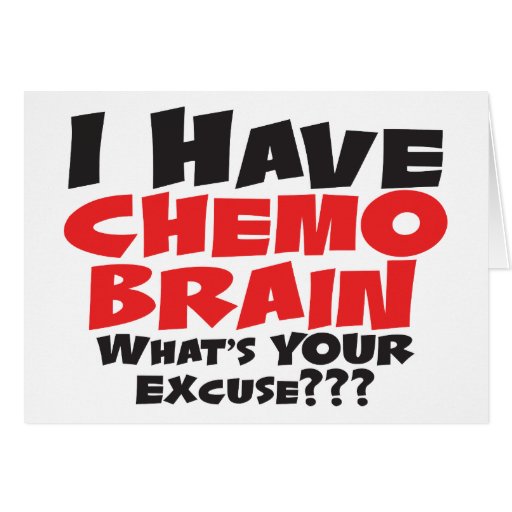
Chemobrain: The first of these problems that you (as the cancer patient) might come across is a little (not so little) something called chemobrain. Essentially, chemobrain is a decrease in mental acuity that generally manifests itself as issues with concentration, memory, and a general sense of not functioning at the same level of mental sharpness as one did before treatment. To put it simply, your brain doesn't work as well as it did. You might lose things easier, forget dates, important bits of information, have difficulty focusing on a task at hand, not do as well on a test, have trouble following a conversation, etc. At the moment there are several theories as to why people go through chemobrain, but none has been definitively proven, and besides, the goal is not to cure the chemobrain, but to find ways of coping and negotiating your way around it. Here's some tips:
  • Make lists: As soon as somebody tells you something, write it down! Whether it's groceries you have to pick up, medication you need to take, or movies somebody tells you that you should watch, be sure to write it down as soon as you hear about it, that way you have a visual reminder of what you need to do and can refer back to it if your memory proves to be stubborn and unhelpful. And be sure to cross off any item that you complete as well, you don't want to do it twice. 
  • Get a planner or notebook: Similar to the previous tip, a notebook will allow you to jot down any old thing that you may need or want. Somebody tells you a funny joke? Write it down! You need to remember somebody's name or information? Write it down! Have an appointment you need to keep? I'll let you guess what you should do. A notebook basically functions as a paper/electronic  (if you want to use a computer instead) memory bank that you can fill with whatever information you deem worthy of retaining. Don't be shy about writing things down either, even if you aren't sure whether it's important or not, write it down anyway, you never know. Besides, notebooks aren't really that expensive, feel free to fill up as many as you please!
  • Keep a journal: Remembering how you feel on certain days can be helpful, especially if you have a problem that has been going on for a few days and you need to keep track of it. Having a detailed account of your physical, emotional, and mental well-being might also make for interesting reading for later as well, when you're telling people about how freaking awesome and brave you are after undergoing your treatments.
  • Avoid distractions: When you need to concentrate on a task and have trouble with focus, making sure that you are in an environment where nothing is going to break your train of thought is important. Personally, I have trouble with this (even in quiet environments, I have a weird habit of breaking my own line of thought with excessively random tangents), and I find it incredibly
    helpful to be somewhere nice and quiet where I can count on being able to do what needs to be done without having some six-foot noisebox (also called a human) come in and talk about their cat while I'm trying to write a blog post. Don't hesitate to tell your friends or family that you need some time to think while you complete your chore or task, they'll understand. 
  • Talk to your nurse or oncology social worker: These people will be able to give you some more useful facts and tips about chemobrain and other problems that you may encounter during the course of your treatment. They are an invaluable resource that you should use often and freely. For more tips on how to combat chemobrain, see CancerCare's article: Combating Chemobrain
Drug dependence: An issue with treatment is that it can cause additional pain. To deal with the pain, narcotics are very commonly used. Based on the nature of this point, you may worry about addiction, but actually addiction is different than physical dependence (which is what this part is about). Addiction is characterized by the compulsive use of drugs (in this case prescription because you will likely have access to a lot of those) for for mood-altering effects rather than pain relief. I went down the road of addiction, but it's not too common to go to that extreme, so don't worry about that. What you do need to concern yourself with is physical dependence, which will show up as you come off of the drugs. You may notice side effects such as: anxiety, paranoia, agitation, sweating, diarrhea, and insomnia. It is possible to notice these signs and work toward ensuring that you come off of your painkillers without suffering too much in the way of withdrawal effects, because you have enough crap to deal with already. 
  • Talk to your doctor if you have concerns about drug dependence and if you notice that you are asking for the drugs even when you don't need them, tell somebody immediately, because addiction is a beast you do not want to tangle with, it can get you killed if you aren't careful.
  • Don't be afraid to ask questions about the types and doses of painkillers you are on. If you are in more pain, don't worry about getting "hooked" on your drugs, because your main concern should be staying as comfortable as possible rather than toughing out extra pain due to a fear of becoming reliant on your drugs. 
  • The best way to mitigate the effects of withdrawals is to come off of your dose slowly, lowering it a little at a time until finally you can come off it completely. Talk about a plan to wean you off your drugs with your doctor. 
There is one more big effect that is almost taboo to talk about, yet should come as no surprise to anybody. Sadly, I'm a tease, and if you want to learn what this last problem is and learn ways to alleviate it, tune in later this week for the conclusion of Awareness Week.

If you found this post helpful or enjoy this blog as a whole, please subscribe by clicking on the button to the right (of the screen, not in three-dimensional space) and/or leave a comment below. Also, I would appreciate it if you shared this with somebody who might be able to put it to good use, you'll gain a smidgeon of karma if you do and who knows, if you share it with enough people the universe might look kindly enough on you to let you win the lottery! (Doubtful, but you never know!)


Thank for for the repurposing today blog, mucho appreciado, your cliffhanger loving master and commander, Andrew

Monday, March 24, 2014

Awareness Week: Surviving Cancer

Hi blog (and others),

Well I promised today (and the rest of the week) would be the start of Awareness Week. So...without further ado, awareness!

A little introduction though. If you look to your right (on the screen, not actually to your right), you'll see the "About Me" thingamajig. Read that. Then look here. I'll wait...good! So yes, I had leukemia (AML to be specific), and have been in remission for about six years now. Obviously some treatments have changed, however, the methods for actually surviving have not. You see, surviving is actually about 85% mental by my estimates. Maybe less. More. I dunno, I'm not a statistician, but in any event, that's my guess. It also works for life in general when things are tough, but for the sake of argument and because this is, at its core, a cancer blog kinda in a way, we'll focus mostly on surviving cancer. So here are five very helpful tips for surviving cancer (and most crappy things life throws at you).


Yes I made a snazzy poster. With colors and pictures no less! (I'm not a huge color person, you don't want to see me wearing red, it's horrendous) And now, some further comments about the above tips.

1. Positivity: It's what it sounds like, the word positive being a major clue. I've actually read studies backing me up, although I am far too behind with this post to actually go find them right now, so you'll just have to take my word on this. Staying positive and keeping a good attitude even when things get bad or you're in a lot of pain actually helps an enormous amount. Not only will your chances of survival increase by a statistically relevant margin, but people who have a positive outlook actually have less pain than people with a negative outlook. So the tip? Flash that beautiful smile and assume the best, because it might just save your life!

2. Laugh loud and laugh often: Following a similar line to the previous tip, try to find some humor in life. It may seem dreary or bleak, hospitals can be very bland places, but find ways to spice it up! Post funny pictures on your off-white walls (you know they are), watch funny movies, listen to your favorite stand up comic, watch old reruns of good sitcoms (preferably ones you like), read a humorous book, have people send you jokes to put in a scrapbook, play benign practical jokes on your doctors and nurses (pretending you've lost an eye by putting Jell-O between your fingers and holding it up to your eye is perhaps borderline), stuff like that! Just like the statistic of positive thinking increasing your chances, you're more likely to be in a good mood if you've been laughing. It may hurt a little, but a bit of pain is a small price to pay for a few joyful tears and grin.

3. Surround yourself with support: It's always helpful to find people who will be there for you when the going gets tough. Family is a good first choice, most families will be more than willing to offer as much assistance as you need and will continue to give it even when things get really rough. Find some really good friends, ones you can depend on to stick with it. There will inevitably be people who will initially offer their support but soon disappear. Don't worry about them, cancer is an unnerving beast at the best of times, some people have a hard time coping with that and don't know what to do. Try not to get mad at them, it's just humans being humans. Instead, focus on how great the people are who stay! Those are the true gems in your life, treasure them always! And remember, don't be afraid to ask for help when you need it, because the people who really care about you will be there by your side.

4. Find a hobby: I know you probably won't have a ton of energy to do stuff, so I don't expect you to go out searching for silver in the Andes mountains in your free time or anything like that. But really do consider finding something you truly enjoy a great deal. Ideally something you can do sitting or lying down. It doesn't necessarily matter what, as long as it makes you happy and passes the time. Time is something you have a lot of and it's good to do things that you like so it seems to just fly by! There's not much more dreary than sitting in a hospital room doing absolutely nothing for hours on end, I can testify to that with much gusto. If you can do something enjoyable, learn a new craft or make something awesome, then I guarantee that it'll be time to go to sleep before you can say "Wow look at this perfect scale model of the International Space Station that I made!"

5. Don't be afraid to ask questions: Doctors are (usually) very smart. They know a lot of things. This means that if you have a question about this or that, they can probably answer it. Just because it can be difficult to follow your treatment plan or there's eight quadrillion different drugs that you have to take doesn't mean you have to sit clueless in your hospital bed staring blankly at a droning doctor until your eyes get stuck that way. If you don't understand something, ask! And be sure to do research as well, there's new treatments coming out all the time, there might be something beneficial that hasn't been explored too thoroughly yet. See what your doctor thinks of that. The nurses too are genius, they know all sorts of little tricks for combating all kinda of ailments, see if they have advice for you. I promise that one or two of them will come up with something that might be of use to you. If not, ask someone else. From my experience the nurses in oncology wards are some of the best around, don't be nervous about asking somebody a question or two, they don't bite (and if they do I bet you could make a lot of money off of a lawsuit so it's a win-win really).

Well that concludes part one of Awareness Week. Click the "Subscribe" button off to the right to get a notification of the next edition coming soon to this blog near you!

And blog? Thank you for being so understanding and letting me post a bunch of semi-ridiculous pictures up on you, I know how much you hate pictures. I dunno why, you're kinda weird.

Sincerely, your pictorially-enamored master, Andrew